
This page was created on July 10th, 2025 and was last updated then.
1. We say “Yes” more often than we say “no.”
We were 6 days into a weeklong trip. It was breakfast at Pierre’s place in Oussouye, which means fresh bread, local honey, papaya jam and a delightful lemongrass tea. One of the clients was talking about artisanal beekeeping. Another guest at Pierre’s — a woman who has been coming to the Casamance for over 20 years — overheard our conversation and gave us a tip. She knew a beekeper on one of the many islands in the bolongs south of the Casamance River.
Going to this island was not part of our original plan, but the clients were up for an adventure. And we say yes more often than we say no.
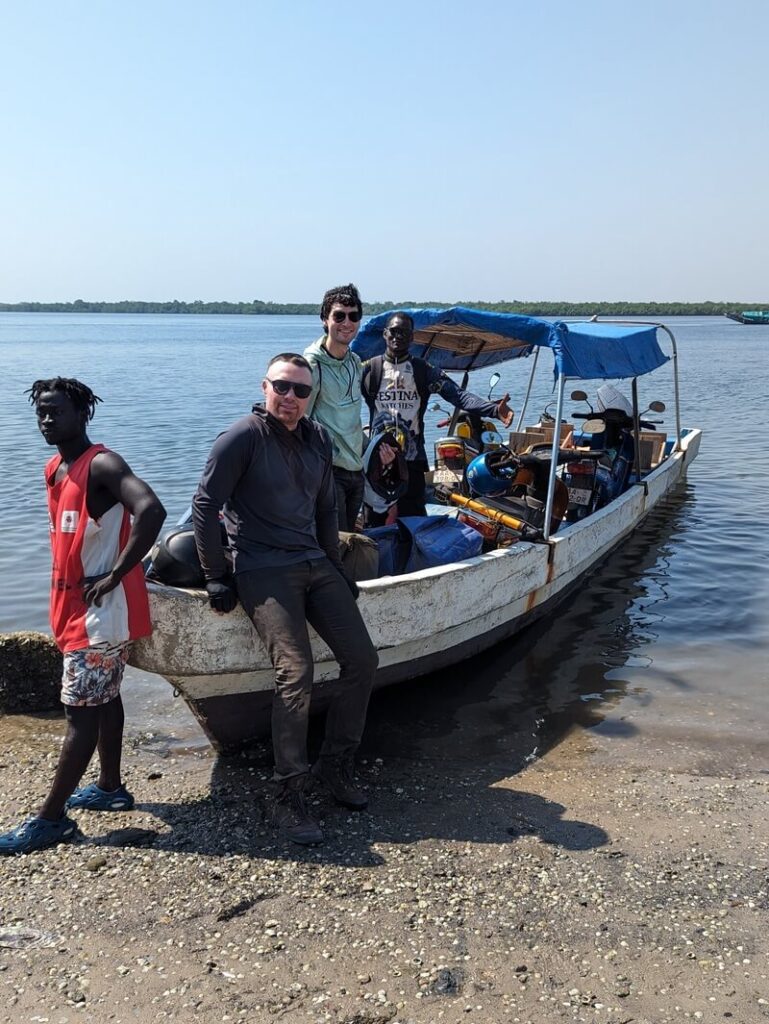
Doing a trip on small motorbikes means we can go everywhere. Jungle footpaths provide some of our favorite riding terrain. The bikes are also small enough to fit on a canoe. And you can easily throw several of them onto a bigger pirogue, which is what we did after visiting a two-story earthen house in Mlomp and climbing a 25m high platform in the jungle.
We’ve become very comfortable with improvisation. The Pivot. Taking a chance on something. Notice I didn’t say “risk” – this is not about compromising our safety. Matt and I are not exactly adrenalin junkies. But we do like new experiences. Sometimes a new experience can be underwhelming, but it is almost always a chance to learn something new, and often, it’s much more than that.
As we sipped our lemongrass tea, I hatched a plan with Pierre that could put us on a boat around lunchtime. He put us in touch with his mate Mamadou, who had a small lodge on the island of Efrane. We worked out a price for Mamadou to take us to Efrane for lunch, Vinday to try and spot some artisanal beekeeping and then all the way down to Katakalousse, where we would take the bikes off the boat and continue on the road to Cap Skirring.
It looked something like this:
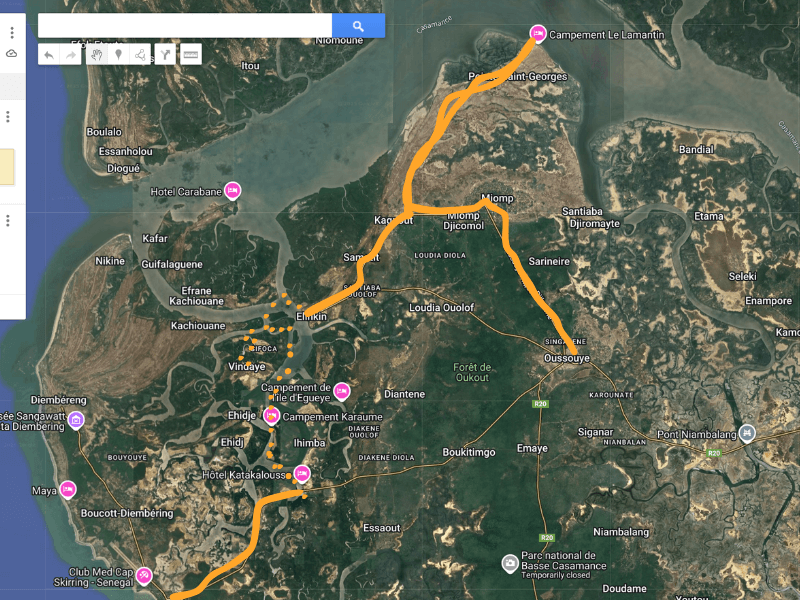
Up to Pointe Saint-Georges
After breakfast, we took off for Pointe Saint-Georges. (This was all part of the original plan). The first stop was Mlomp (pronounced “MmLomp” — there are a lot of really fun village names in this part of Casamance, i.e. Djibonker, Boukitingo, Boudediet). Mlomp is 10km from Oussouye on potholed tar that is probably really irritating in a vehicle. It’s a joyride on our bikes. In Mlomp, we stopped to visit a two-story earthen house.
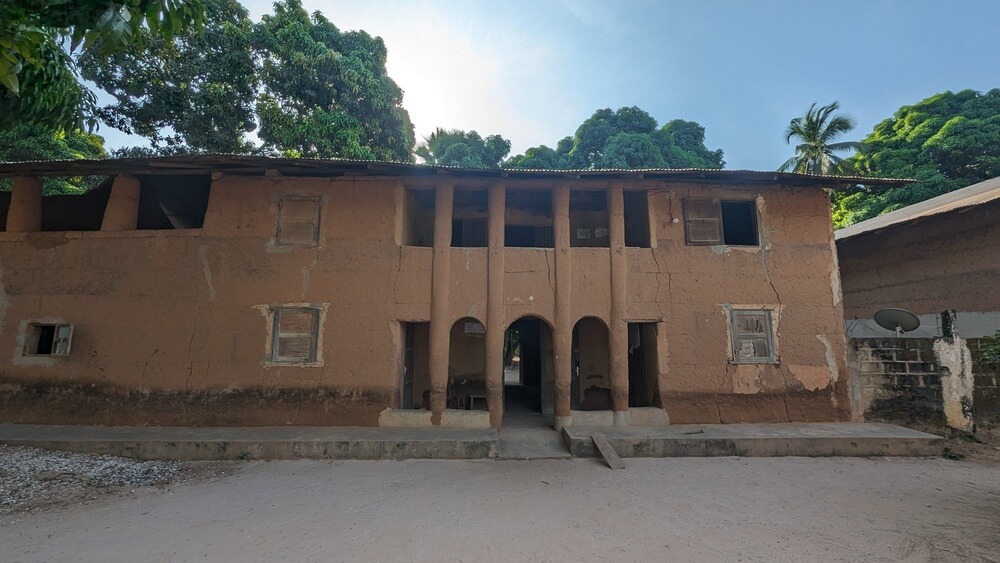
The story goes like this: Etienne Diatta was conscripted to fight for France in the second world war, during which he saw multi-story homes for the first time. Upon returning to the Casamance he decided to build one himself, but entirely with traditional materials. Banco, palm trunks, mangrove branches. It’s a rather stunning feat of engineering, and outside of cosmetic renovations and a zinc roof, the structure is the same as it was when it was first built. The family opens up their house to visitors (a small donation is encouraged) and in addition to the tour, you usually end up with some complimentary palm-wine underneath the mango trees out back.
Afterwards, we continued on the tar to Kagnout, where we took a red laterite road up to the point. I absolutely love this ride. Open grassland with a few patches of forest to keep things interesting.
We had a refreshment at Pointe Saint-Georges at our favorite campement, Le Lamantin (“the manatee”). It’s right on the river, and if we hadn’t shifted gears with the itinerary we would have had lunch here. The timing was not in our favor on this day, but at low tide you can spot manatees who are drawn to a freshwater spring that bubbles up in the river.
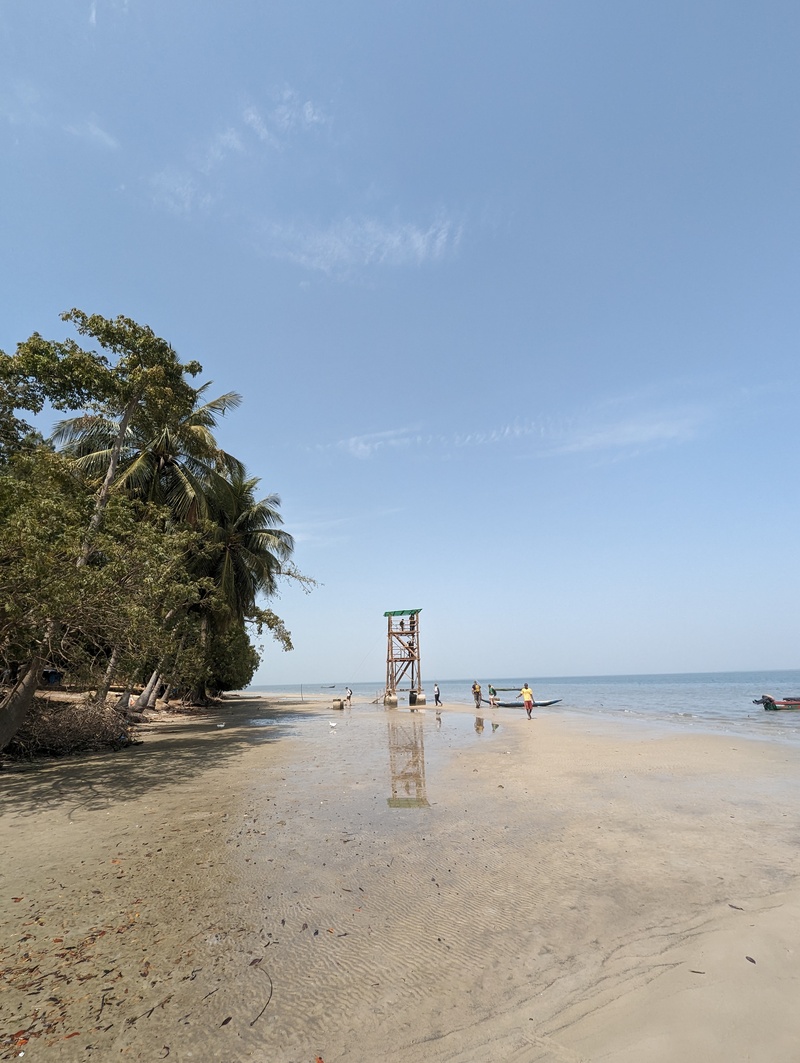
What it looks like at low tide (pic from a different trip in 2024)
After PSG we headed south on the same laterite road. We had an extra passenger now, one of the guys from Le Lamantin, who was going to help us climb up a 25m platform in the jungle.
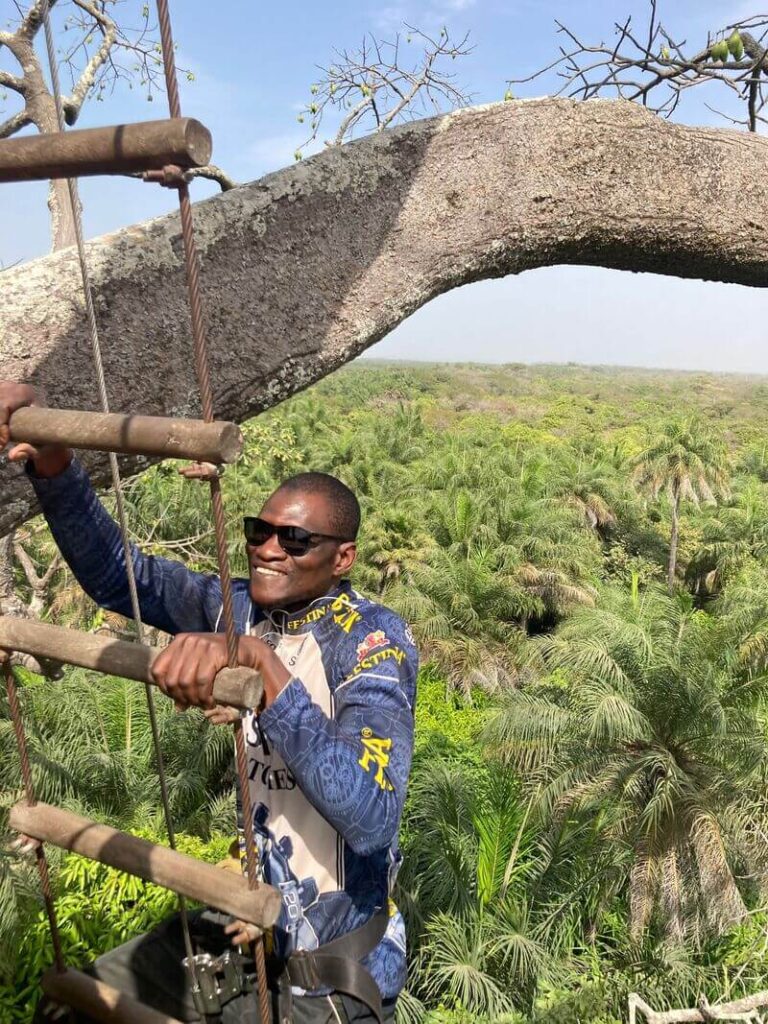
Boubacar climbing up to the platform.
I am not fond of heights, but the clients enjoyed both the climb and the view. I was content on the ground, looking for birds in the cool forest air.
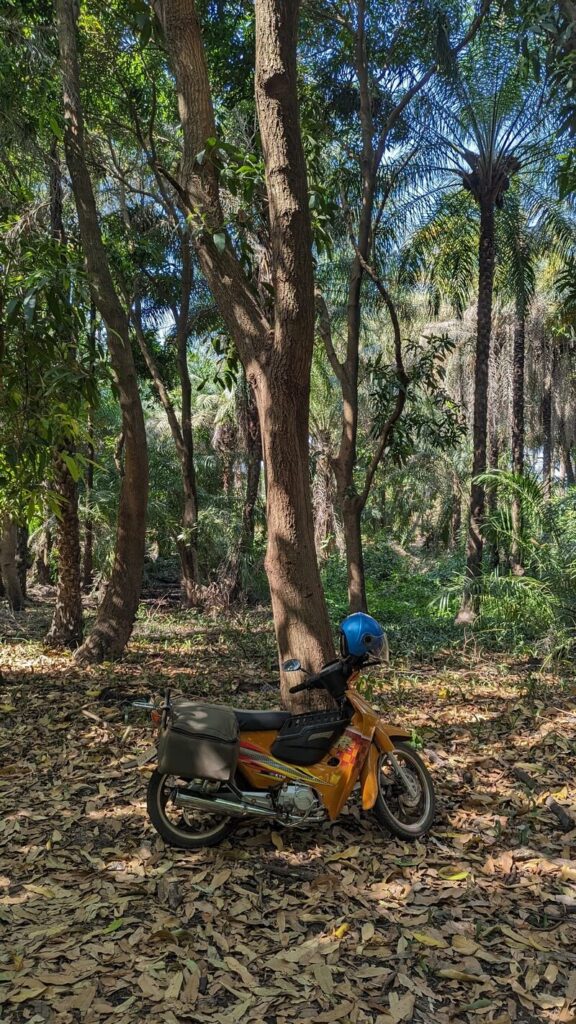
bike parking in the forest
Loading up the bikes
Post jungle climb, we had a short ride to Elinkin, where we met Mamadou at the water’s edge. We tossed the bikes on his boat, paid a quick visit to the gendarmes, and crossed the channel to Efrane.
At Mamadou’s place, we were immediately treated to fire roasted oysters. There were so many oysters that I thought it was actually the main course. It was, in fact, the entrée.
After building a small mountain of discarded shells, we were directed to the dining room:
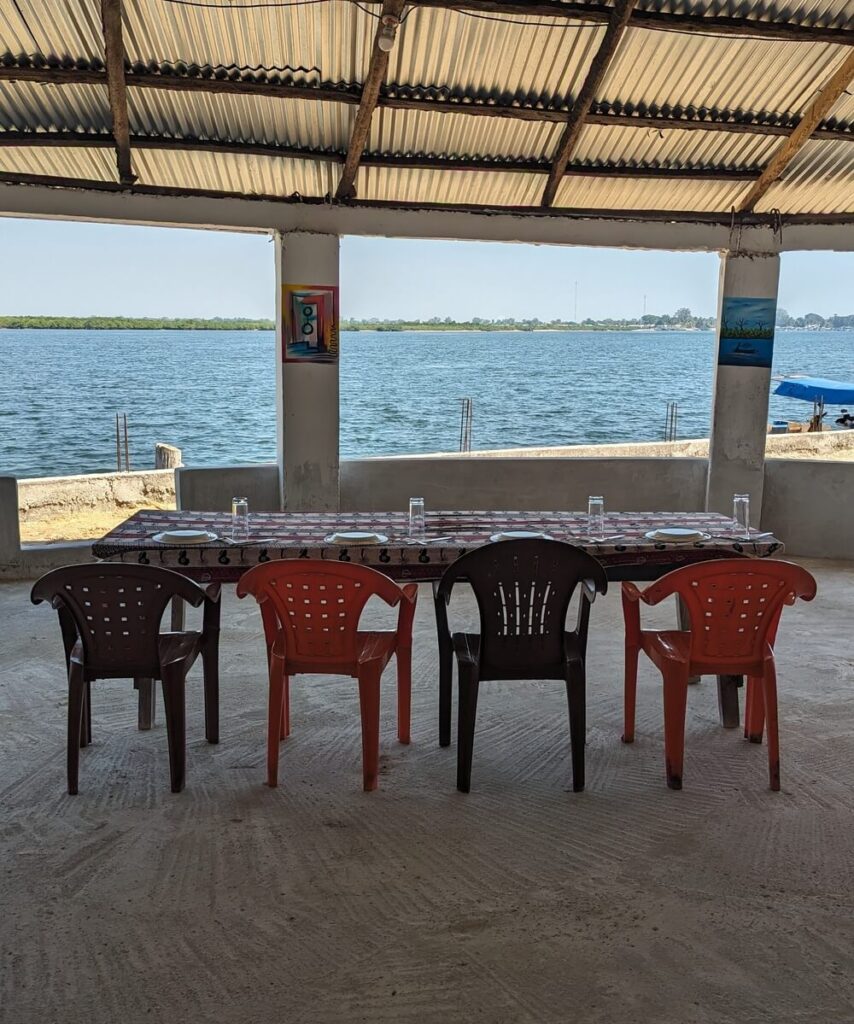
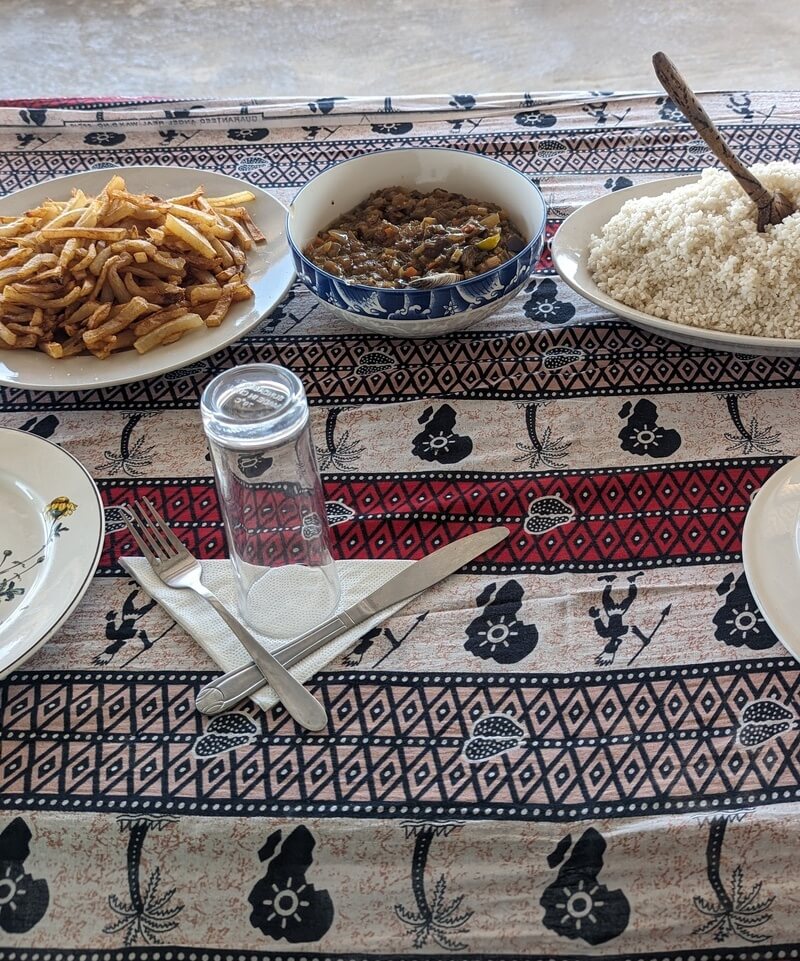
Lunch was a delicious fish yassa served with rice and frites. They were able to rustle up a couple of frosty Flags as well. It was perfect.
After lunch, we got back on the boat and crossed the channel to Vinday, making our way through the twisting, narrowing bolong to get to the interior of the island. The tide was going out and I did wonder about the possibility of getting stranded. But Mamadou and the driver knew what they were doing.
We made it to the village and wandered up to the “place publique” – the town square – which, in these parts, is always underneath a large kapok tree. Animism is still widely practiced here and many of the kapoks serve as spiritual conduits (“fetishes”) – intermediaries between the physical world and beyond.
This particular kapok was nearly engulfed by strangler figs, and it was draped in a striking necklace of bones. There was no one around. The village was empty. Everyone was out fishing or tending their fields. Stumbling across a tree like this in mid-afternoon silence does something to you.
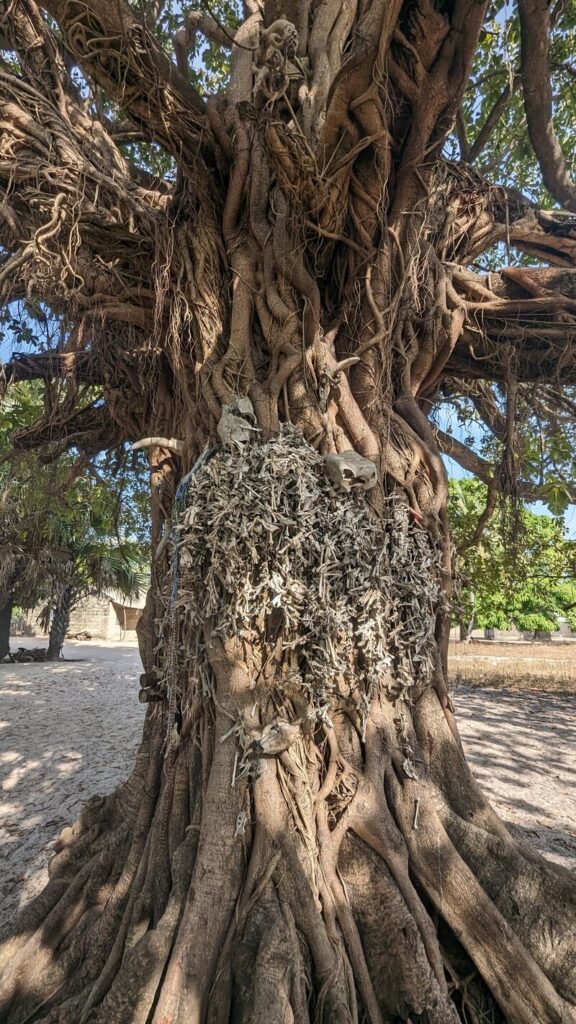
If the clients still had doubts about the extent to which animism is practiced in this part of Senegal, those doubts were gone now.
At the base of the tree, there was a jet black bombolong. The bombolong is a large drum that is carved out of a single piece of wood. It is mysteriously hollow despite having only one narrow opening, and perhaps even more surprisingly, it is used as a telephone rather than a musical instrument. The drum can be heard several kilometers away and the various rhythms are actually coded messages announcing weddings, funerals, baptisms and other important community events.
We never found the beekeeper, but we did find the apiary. It was in the mud flats that led into the mangroves. Other than its location, there was nothing exceptional about it. I tried ringing the beekeeper several more times, but it went straight to voicemail.
We hopped back in the boat and continued our journey south, passing several other islands before we arrived at Katakalousse. It was time to get back on the bikes for a short 14 km ride to Cap Skirring.
This side quest to Vinday could have been seen as a failure. Finding the beekeeper was our stated mission when we shook up the itinerary. But this is why one of our mottos is, “things don’t go wrong, they just might not go to plan.” No, we did not find the beekeeper. But we put our bikes on a boat and took a scenic ride through the bolong. We ate a delicious fish yassa and oysters plucked from the mangroves. We saw a fetish that I’m still thinking about.
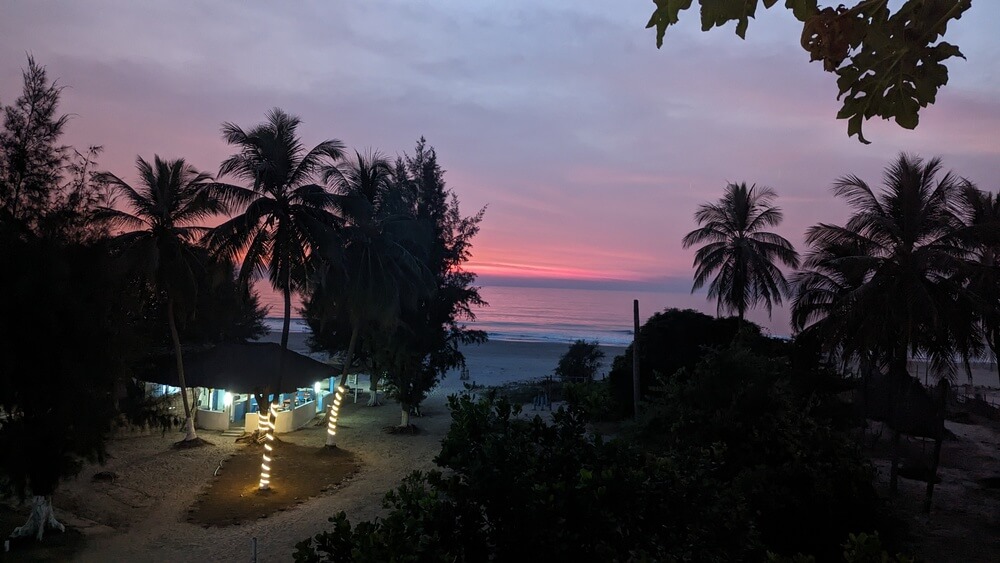
And after it all, we still arrived on the beach in Cap Skirring for this sunset.
I made a 90 second video re-cap of this weeklong trip here.
Every trip is different, but if you are interested in doing something along these lines, check out our one week trip to Senegal, The Gambia and Guinea-Bissau.
0 Comments