
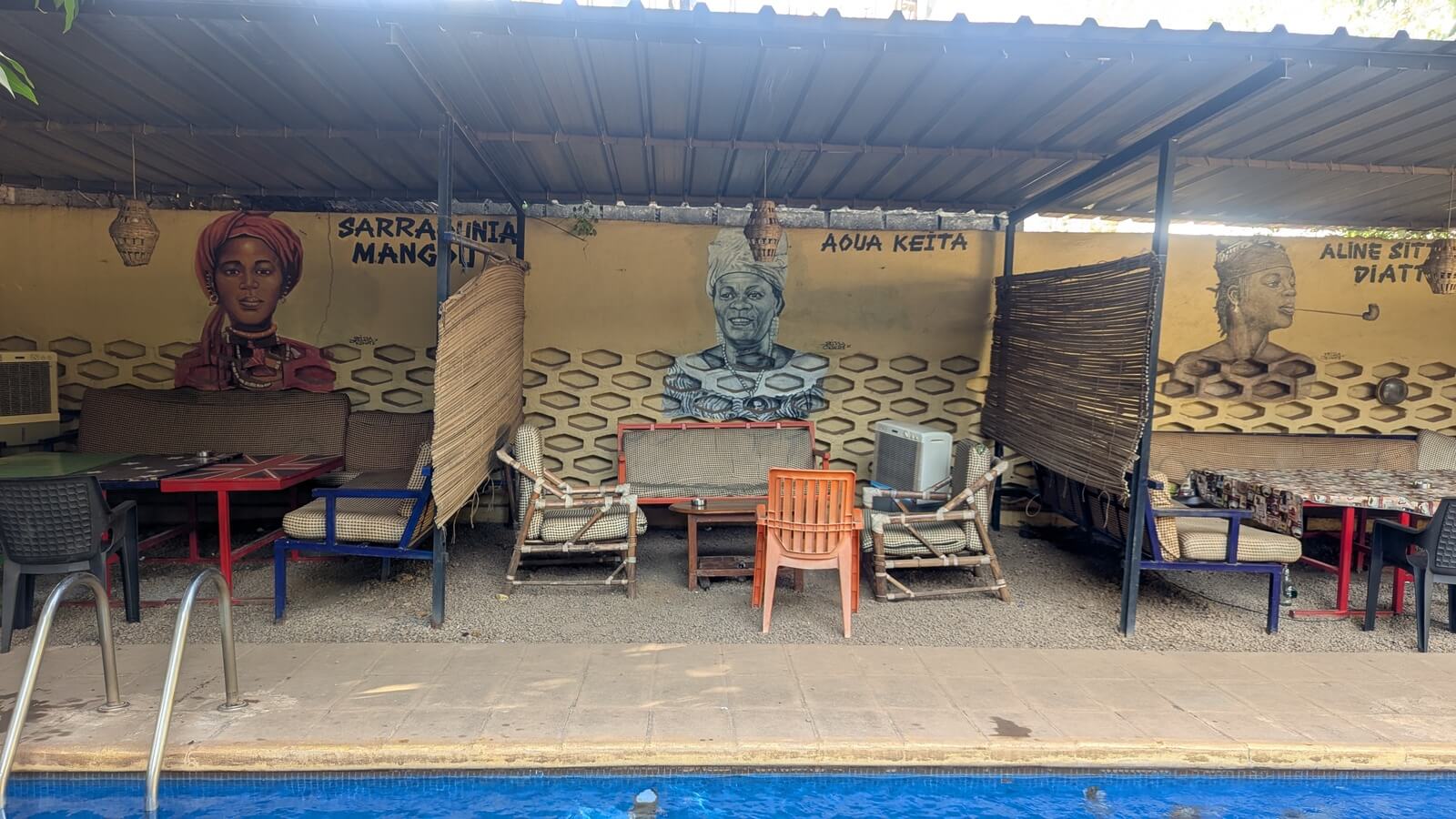
At our hotel in Bamako, the Sleeping Camel, you can drink a cold drink under the steady gaze of three women who refused to stay in the background of West African history. Their portraits hang together, not because their lives intersected, but because each left a lasting mark on the place she came from.
Aoua Keïta — Mali
Born in Bamako in 1912, she trained as a midwife and spent her life in the middle of Mali’s fight for independence. She became an activist in the US–RDA party, worked in trade unions, and pushed hard for women’s rights in a political space that had little interest in hearing them. In 1975, she published Femme d’Afrique, the first autobiography by an African woman in French, documenting not just her own story but the political climate of the time.
Sarraounia Mangou — Niger
The queen of the Azna in Niger earned her place on the wall in 1899, when she fought the French Voulet–Chanoine expedition. While much of the region folded under French pressure, Sarraounia’s forces resisted and she survived, continuing to rule. Her defiance was later immortalised in Abdoulaye Mamani’s novel Sarraounia, which cemented her legend beyond oral history.
Aline Sitoe Diatta — Senegal
In the 1940s, the woman who would become “La Jeanne d’Arc de Casamance” led a tax revolt in southern Senegal. She urged her community to return to traditional farming and resist French demands to grow peanuts for export. For her trouble, she was arrested and sent into exile in Timbuktu, where she died in 1944 at the age of 24! In Casamance, she is remembered as a symbol of resistance, with annual commemorations in her name. Her memory also sails the waters between Dakar and Ziguinchor, the main ferry on that route still bears her name, carrying people and goods along the same coast she once fought to protect.
We chose to celebrate the lives of these women on our walls. History in West Africa is often told through the lens of men, and the full picture only comes into focus when everyone’s in the frame. Learning doesn’t stop, and stories like these are worth hearing more than once.

0 Comments