

From space, the Sahara looks endless. Then, in the middle of Mauritania, a strange swirl interrupts the monotony: a giant target about 40 kilometers across. This is the Eye of the Sahara, better known to geologists as the Richat Structure. Astronauts use it for orientation, while most people on Earth have only ever seen it in photos.
On our Mauritania trips, we make a point of going there.
The geology behind the richat structure
The first theory was that a meteor hit Mauritania. That fell apart when geologists couldn’t find any of the impact evidence you’d expect, like shocked quartz or melted rock.
Conspiracy theories aren’t new. In the 1960s, French geologist Jean‑Paul Berthélemy linked the Eye of the Sahara to Atlantis, pointing to Plato’s tale of a city built in concentric rings. Writers like Robert Schoch and a wave of YouTube theorists kept it alive. The geology says otherwise, but who doesn’t love a good story?
.If you want numbers: the Richat Structure is 40 kilometers wide, made up of limestone, sandstone, and volcanic rock, with layers ranging from about 100 million years old at the outer rings to nearly 500 million years at the center.
A BIT OF HISTORY
The Eye wasn’t “discovered” in the sense of someone stumbling upon it. Nomadic Berber communities around Ouadane have always known about the rock formations. French geologists mapped it in the 1930s. The rest of the world noticed in the 1960s, when astronauts photographed it during the Gemini and Apollo missions.
That’s when the Eye became a landmark, not for caravans but for people looking down from space.
OUR TRIPs OUT TO THE EYE of the sahara
The Eye isn’t a casual stop. You go there because you plan to. The route runs Atar → Chinguetti → Ouadane, and then we keep heading east. Ouadane is the last real settlement: an old Saharan town with a long history as a caravan stop. Today it’s a quiet base for exploring the desert, with a handful of guesthouses and plenty of space to wander.
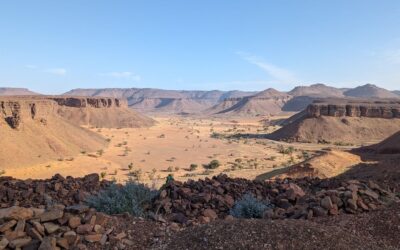
Driving beyond Ouadane is when you start to feel how far you’ve come. The Richat Structure isn’t visible as a perfect bullseye from ground level. Instead, you’re moving through ridges of rock curving in wide arcs, a landscape that feels different from the endless flat sands.
Where we go from there depends on the trip. Sometimes it’s an out-and-back. Sometimes the Eye is a waypoint on a longer push deeper into the Sahara. Either way, it’s never just a quick look and leave.
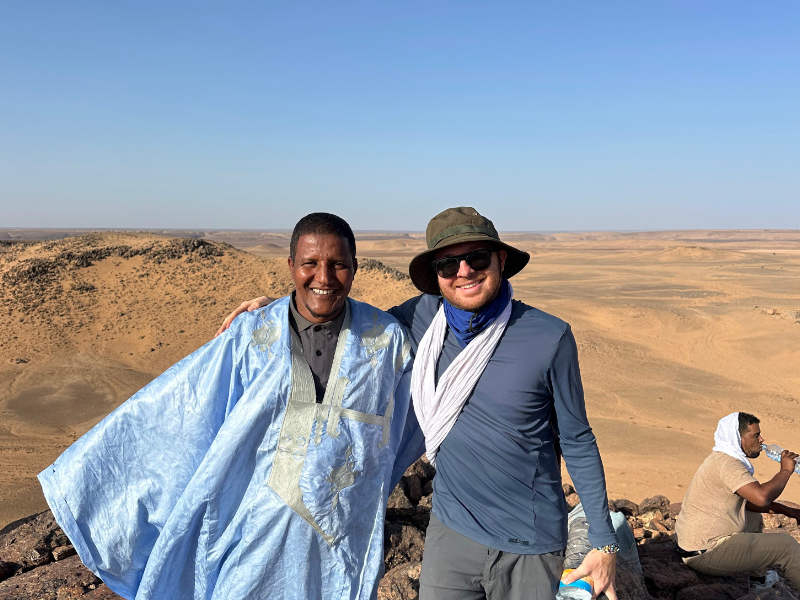
WHAT IT’S LIKE ON THE GROUND
Forget the astronaut photos. At ground level, the Eye is less about symmetry and more about scale. You’re standing in a geological structure big enough to be seen from space, in one of the most remote parts of Mauritania.
The sense of isolation is part of the appeal. Ouadane is already quiet; beyond it, the Eye feels like the edge of the world. You get the rock arcs, the wind, and the space to take it in without anyone else around.
VISITING ON OUR TOURS
The Richat Structure features on our Mauritania itineraries as part of a wider loop that takes in Atar, Chinguetti, Ouadane, and beyond. The exact plan depends on the trip, the weather, and the group. The Eye of the Sahara is one of those points that makes Mauritania more than just a line on a map. It’s a place you can actually stand in the middle of something most people only see on a NASA slideshow.
PRACTICALITIES
- Best time to visit: November to March. Summer is brutally hot.
- How to get there: Usually from Atar through Chinguetti to Ouadane, then out to the Eye. 4×4 required.
- Accommodation: Basic auberges in Ouadane. Limited facilities.
SEE IT FOR YOURSELF
Thinking about seeing the Eye of the Sahara for yourself? We visit the Richat Structure on our Mauritania trips, along with Chinguetti, Ouadane, and the Adrar. See our Mauritania tour here
I would like to visit the eye of the Sahara . Besides 4-4 do you fly ? Also I hear that you have a train that you can go inside in a short hours that you can do on the Sahara and avoid the iron train because we are senior and no very recommended for us
Hi Eida, we do not fly domestically within Mauritania. All of the trips we do are with 4x4s. And I am not aware of another train besides the iron ore train. Perhaps you are talking about riding in the passenger car of that train and taking it from Zouerat to Choum instead of going all the way to Nouadhibou?