
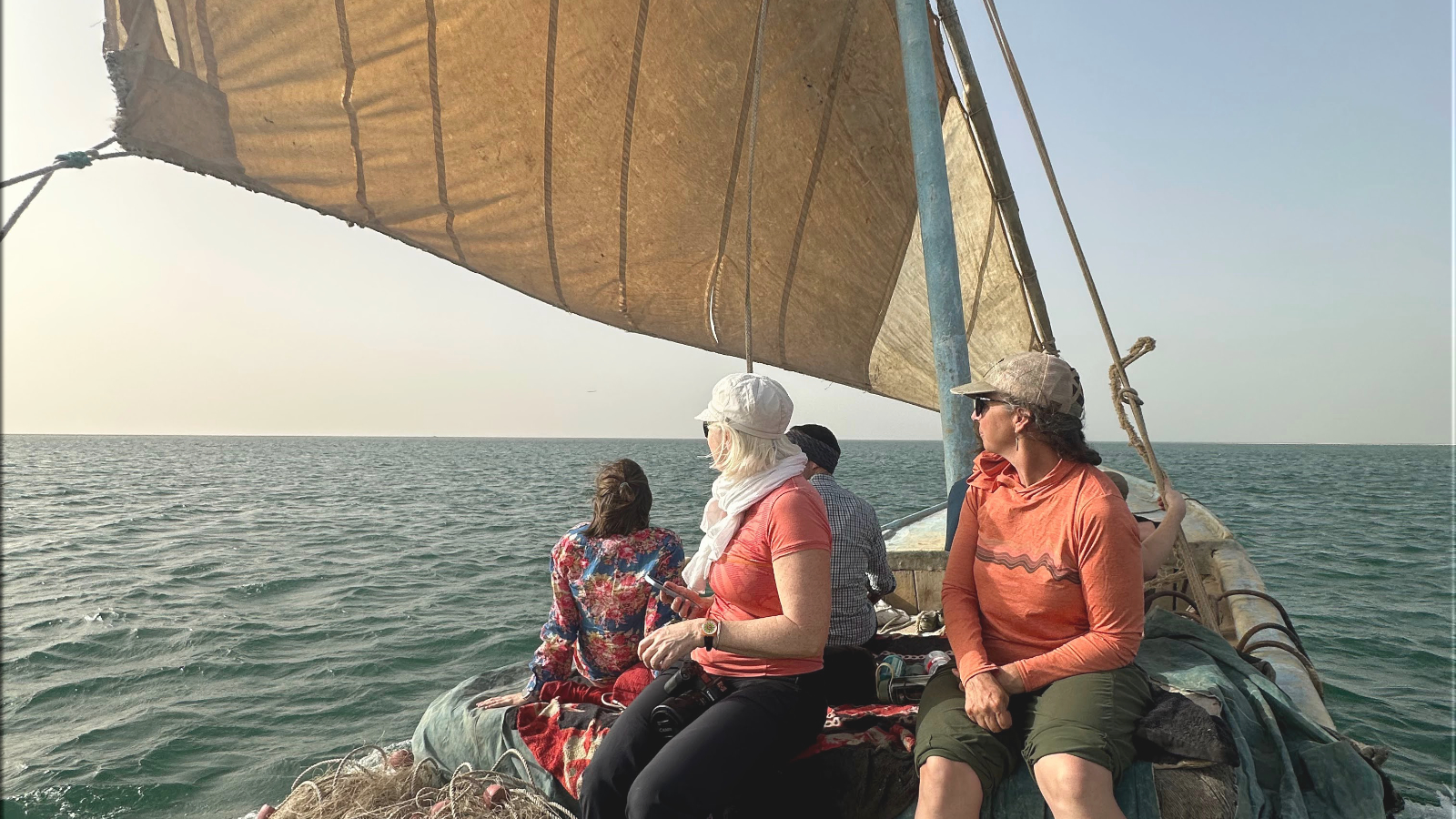
The Imraguen are a small fishing community spread across nine villages inside Mauritania’s Banc d’Arguin National Park. If you travel with us on our Mauritania tours, you will almost certainly meet them. And if the wind and tides play along, we might take a sail in a lanche, the broad hulled boats they have used for decades.
They still fish under sail, without engines. Their villages are inside the park, and they hold exclusive fishing rights here, provided they use traditional methods.
A Fishing History
The name “Imraguen” is usually translated as “people who fish by walking on the sea.” A few generations ago, their most distinctive method involved an unlikely partner: dolphins.
Fishermen waded into the shallows, whistling to attract Atlantic humpback dolphins, which herded mullet toward shore. The fish were taken in nets, processed by the community, and every part of the catch was used.
The tradition has not vanished from memory, but it is rarely practiced today. By the 1990s it was already becoming uncommon, and park rules, smaller fish runs, and fewer dolphins have made it an exception rather than a rule. On our visits, we have never seen it in action, and local fishermen confirm it is no longer part of regular work.
Fishing Under Protection
Since 2000, the Imraguen have held exclusive rights to fish inside the Banc d’Arguin. In return, they use sail powered boats, approved nets, and follow seasonal restrictions.
The arrangement keeps industrial fleets out of the park. In practice, the area is huge, and there are occasional reports of non authorized fishing. For the Imraguen, the park rules shape every season’s work: where they can fish, how much they can take, and when they can take it.
Environmental Pressures
Fishing seasons are shorter than they used to be, and catches are smaller. That would be enough of a challenge on its own, but the environment brings another problem: debris washing ashore.
Every visit, we see the same pattern: plastic bottles, food packaging, ropes, nets, all caught in the tide line. It is not coming from the villages themselves. Most of it rides in on ocean currents from cities and rivers along the West African coast and further afield.
Plastic and the Park
Mauritania’s overall plastic output is low compared to many coastal countries, but waste management is limited. Plastic bans exist but are inconsistently enforced, and the population growth in Nouakchott puts more waste into the system.
The Banc d’Arguin sits in the path of Atlantic currents that collect debris from a wide sweep of coastline. Once it is in the water, much of it ends up in the park’s shallow bays.
Recent projects with conservation groups are working with Imraguen villages to manage and recycle some of this plastic. It is early days, but at least there is an effort to deal with what the tide brings.
Visiting the Villages
Our tours sometimes stop in villages like Nouamghar or Iwik. If the conditions are right, we will take a lanche out into the shallows. These boats, introduced in the 1930s, are still the workhorses of the fleet.
Fishing today follows the park’s rules, and the pace is set by the wind and the tide. A visit is a straightforward look at life in a protected fishing community, one still working much as it has for decades.
And yes, you will see the debris on the beach. We make a point of explaining that it comes in from outside. It is part of the landscape, but not the source.
Why It Matters
The Imraguen are one of the last sail powered fishing communities on this scale in West Africa. Their work continues because of the park’s protections, and it survives alongside outside pressures, environmental, economic, and ecological.
Visiting an Imraguen village is not a performance. It is a look at a community fishing within the rules of a protected area, in one of the richest marine zones in West Africa.
If weather and tide allow, a sail on a lanche offers a rare perspective: the desert on one side, the Atlantic on the other, and a fishing culture that still moves at the pace of the wind
Thinking of visiting Mauritania? We visit some Imraguen villages as part of our Banc d’Arguin stop on our Mauritania tour.
0 Comments