
Benin does not hold back when it comes to celebrating Vodun Days. Ever year on January 10, the coastal town of Ouidah transforms into the busiest town in Benin. At night it feels like half the country has descended to party into the early hours. Vodun Days is an annual celebration that is part religious ceremony and part street party, with the balance shifting depending on where you are standing and who you are with.
If you have heard Vodun reduced to “Voodoo” or worse, to cheap Hollywood horror tropes, this is the antidote. Vodun Days is a vivid reminder that Vodun is a living faith practised by millions of people across Benin, Togo, Ghana, and the African diaspora. Ouidah is its spiritual heart.
This post breaks down what Vodun Days actually looks like on the ground: the ceremonies, the logistics, and how to experience it without becoming that tourist.
A BIT OF CONTEXT ABOUT VODUN DAYS (VOODOO IT IS NOT)
Vodun Days is sometimes referred to as the “Voodoo Festival” in travel brochures and online articles. That label is misleading. Voodoo is a New World faith shaped in the Americas by enslaved Africans, especially in Haiti and Louisiana. What happens in Ouidah is Vodun, the West African tradition in its homeland.
Vodun (or Vodoun, Vodounsi, take your pick) is a spiritual tradition that predates the slave trade by centuries. Its deities, called loa, are tied to natural forces, ancestors, and community life. The French colonial government tried to stamp it out. Christian missionaries did their part. Neither succeeded.
Ouidah became a focal point for the religion because of its historical role as a slave port. The town is home to key Vodun temples, sacred forests, and the famous “Python Temple”. It is also where the post-independence government officially recognised 10 January as a national Vodun holiday in 1996, cementing Ouidah’s place as the epicentre of Vodun Days.
WHAT TO EXPECT
Ouidah during Vodun Days is loud, crowded, and completely alive. The core of Vodun Days is a mix of ritual, performance, and processions anchored around key sites:
- The Sacred Forest of Kpasse – A shaded grove where high priests conduct rituals, draped in red, white, or indigo. Sacred to the Vodun deity Kpasse, who depending on which version you hear either disappeared into the forest or became part of it.
- The Temple of Pythons – Home to dozens of royal pythons, considered messengers of the deity Dangbé. Expect to see initiates and devotees carrying them through the crowd like sacred regalia.
- The Beach at the Door of No Return – The processions move toward the ocean, where offerings (gin, palm oil, chickens) are made to Mami Wata and other water spirits.
In recent years, Vodun Days has become more organised. There is now a formal programme and mapped-out spaces where different ceremonies, dances, and performances take place. In Ouidah itself, these are not stages in the concert sense, but open areas marked for specific troupes, priests, or community groups. The programme makes it possible to plan your day and move between spaces without relying purely on the sound of drums to guide you.

Organisers have also added seating sections and a paid “VIP pass” that offers shade, chairs, and a roped-off viewing area. In our experience, this is not great value. The fenced-off area separates you from the energy of Vodun Days, and it is harder to engage with the action or dodge the egungun when they barrel through the crowd. Unless you absolutely need a seat, the middle of the chaos is still where the magic happens.
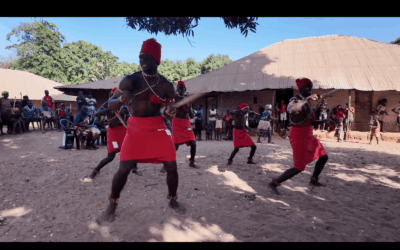
The egungun masqueraders, ancestral spirits embodied in towering, brightly coloured costumes, remain the most electrifying part of the day. The Zangbeto, “night watchmen” spirits, spin in their haystack-like robes to cleanse the streets of bad energy.
LOGISTICS: GETTING THERE
Where: Ouidah, about 40 km west of Cotonou.
When: 10 January is the official holiday, but smaller ceremonies begin a few days before. If you want to see the full build-up, aim to arrive by the 8th or 9th.
Transport:
- From Cotonou, a taxi takes 45 minutes to 1 hour. Expect to pay 5,000 to 10,000 CFA one way depending on your negotiating skills.
- Shared zemidjan (motorbike taxis) are cheaper but less comfortable, especially if you are carrying luggage.
Traffic in and out of Ouidah can be chaotic on the day itself. If you are staying in Cotonou, plan to leave early in the morning and expect delays coming back. Trying to leave the festival at night can be complete chaos. We ended up catching motorbikes back to town and meeting our car on the main highway to Cotonou.
WHERE TO STAY
Ouidah has limited accommodation, and most places fill up months in advance. Your realistic options:
- Casa del Papa – Beach resort about 6 km from Ouidah. It is the most comfortable base if you want distance from the chaos. Rates from around 60,000 CFA per night.
- Hotel de la Diaspora – Midrange, right on the beach near the Door of No Return. Book early. Around 35,000 CFA per night.
- Guesthouses in Ouidah town – Budget-friendly but basic. Expect cold water, variable electricity, and thin walls.
If everything in Ouidah is full, Cotonou is your fallback. The drive is short enough to commute for Vodun Days.
COSTS
Entry to most ceremonies is free. The only fees you might encounter are at the Sacred Forest (typically 2,000 to 3,000 CFA) and the Python Temple (around 2,000 CFA).
Food and drink are everywhere. Street vendors sell grilled fish, chicken, and akassa (fermented maize paste) for 1,000 to 2,000 CFA. Beer and soft drink run about 1,000 CFA.
Guides vary in price. A local guide for the day will run 20,000 to 30,000 CFA. Whether you need one is debatable. If you want in-depth context and help navigating ceremonies respectfully, it is worth it.
HOW TO EXPERIENCE IT (WITHOUT BEING OBNOXIOUS)
Vodun Days is not a “show” for tourists. It is a religious celebration. Respect is non-negotiable. Some practical points:
- Dress: White clothing is common among Vodun practitioners on 10 January. You do not need to copy this, but avoid wearing all black or anything that screams “safari tourist”.
- Photography: Always ask before taking close-up shots of ceremonies, egungun, or individuals. Some areas prohibit photography outright. A polite guide can smooth this.
- Participation: You are an observer. Do not step into dances, touch costumes, or get between devotees and the priests.
If you approach Vodun Days like a street party in New Orleans, you will miss the point. It is better seen as a moving pilgrimage that the whole town participates in.
If you stay a day or two beyond 10 January, Ouidah slows down enough to explore its other sites without the crush:
- The Route des Esclaves – The 4 km path from the centre of Ouidah to the beach, marked with sculptures and historical points tied to the transatlantic slave trade. Once a sandy track, it is now a paved road. Some of the monuments are still in place, but the setting feels different with modern traffic moving along the route.
- Ouidah Museum of History – Housed in an old Portuguese fort, with exhibits on the slave trade and Vodun culture.
- The Python Temple – Easier to visit without festival crowds, though less electric.
IS IT WORTH IT?
Absolutely. But only if you understand what you are walking into. Vodun Days is not just a curated festival with neat seating, stages, and schedules. If you go looking you can find spaces that are messy, hot, and unpredictable. It is also one of the few places where you can see Vodun in its public, unfiltered form, still central to everyday life in Benin.
At night the stadium at the beach feels like a music festival you might find anywhere else in the world. There is also a purpose-built arena where you can pay to see cultural performances. For us, this is where the VIPs go. There is nothing here you will not see on the street in town, and we prefer the rough-and-ready action over the shade and designated seating.
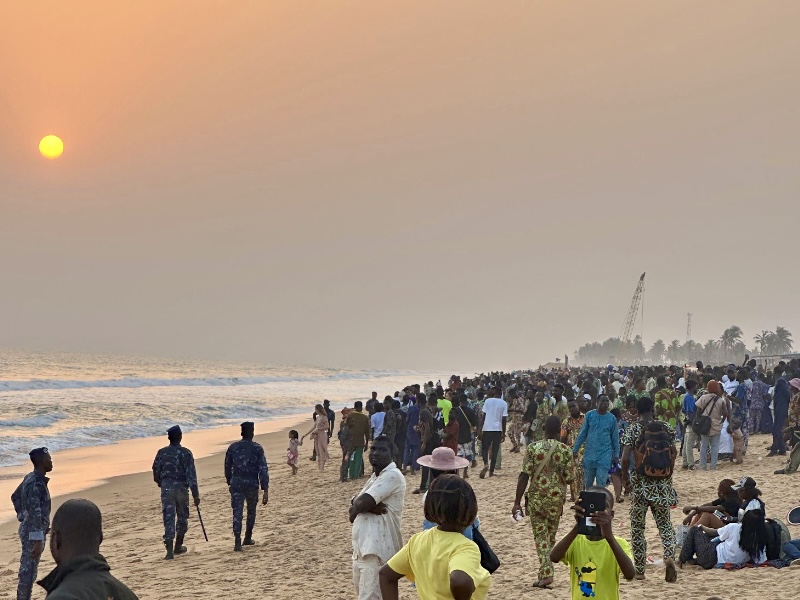
There is a massive stage that hosts various music acts into the night. There are loads of bars and restaurants, and at Vodun Days you can even dip your toes in the ocean. Police patrol the beach to make sure no one goes swimming because Sodabi (the local moonshine) and beach swimming do not mix well.
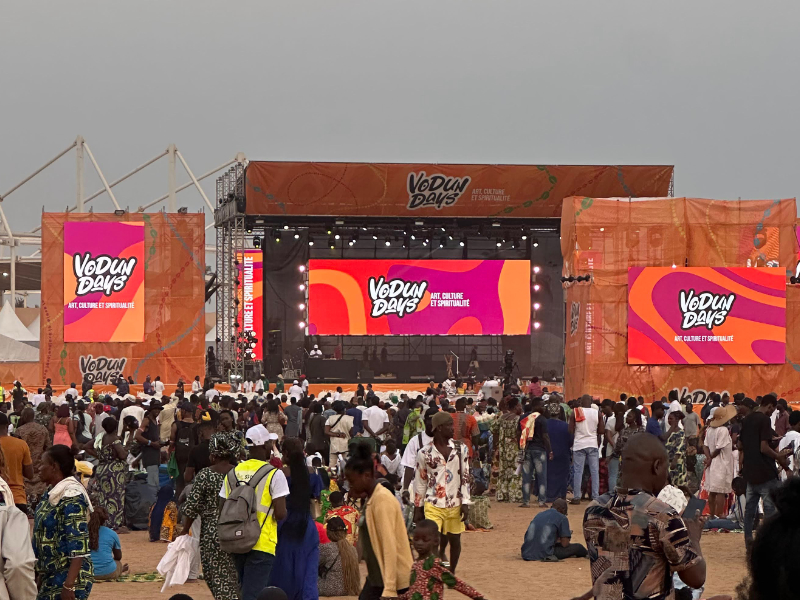
Spend your days in Ouidah town exploring the cultural spaces, then at night head to the stadium at the beach and get ready for a long night of music and dancing. If you are willing to navigate the crowds, the heat, and the occasional confusion, Vodun Days in Ouidah is unforgettable.
0 Comments