
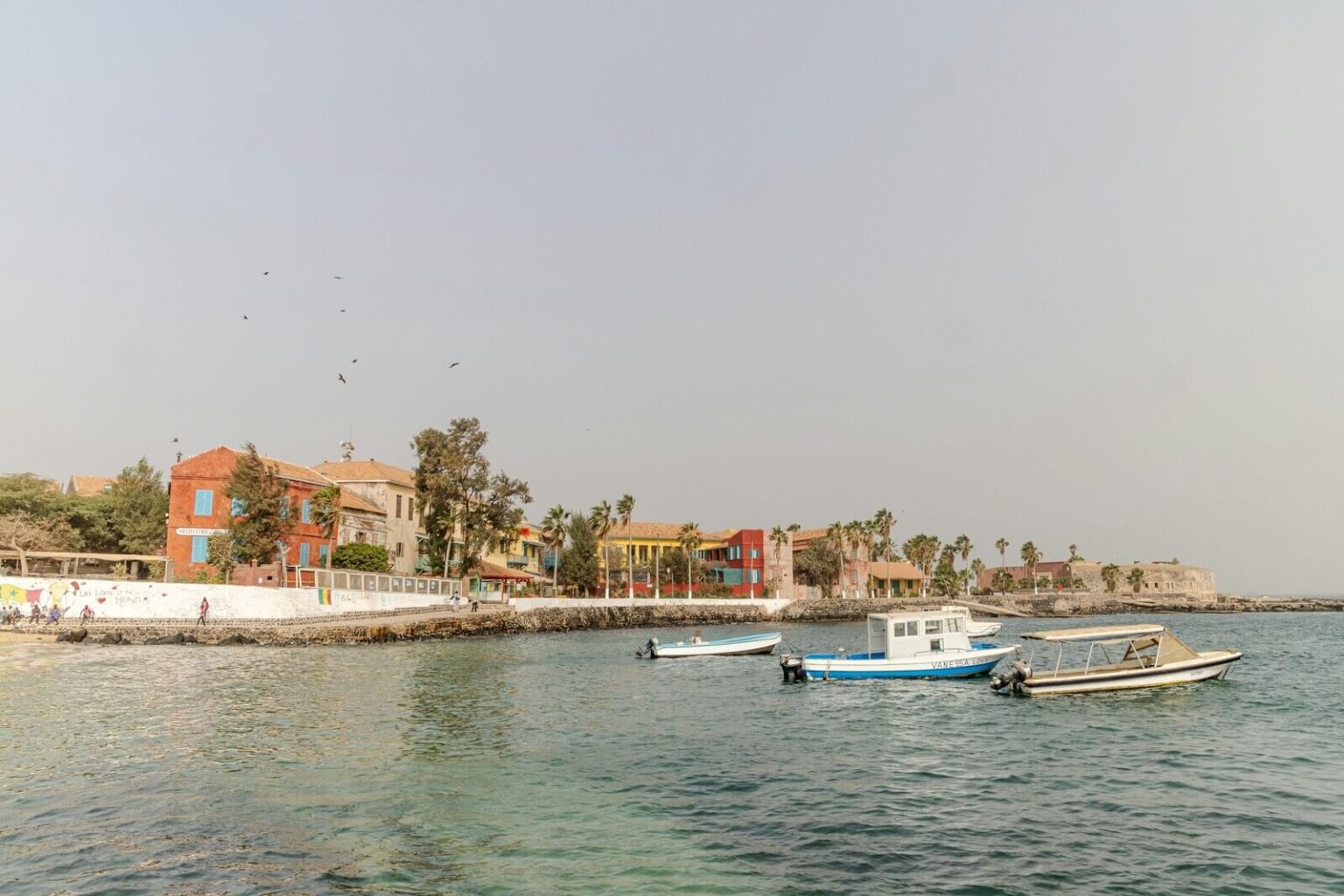
A UNESCO World Heritage site and Dakar’s number one attraction in terms of visitor numbers, Gorée is deservedly at the top of many “things to do” lists, even if aspects of its history and role in the trans-Atlantic slave trade have been disputed. Regardless of how the history has been dressed up, the Slave House on Gorée will still hit you like an anvil.
Gorée is touristy and it can get crowded, but in some ways it is a well-oiled machine. The Slave House (la Maison d’Esclaves) has enough different areas that it rarely feels too packed with people, and the island itself still has a few quiet corners even on the busiest of days. Beyond the history of the place, strolling the cobblestone streets and admiring the colorful colonial-era houses — framed by a riot bougainvillea and the occasional baobab — is a great way to spend an hour or two.
I’ve lost count of how many times I’ve visited Gorée. Needless to say, I’ve learned a few things about visiting the place. This is what you need to know before heading to the island.
When to Visit Gorée Island
In the broader context of weather in Senegal, between mid-November to mid-June is when the climate is at its most pleasant. There is little to no humidity and Dakar is often quite cool due to the sea breeze. When it comes to choosing a day and a time, try to avoid weekends, holidays and school breaks. And, keep in mind, the Slave House is closed on Monday (it is possible to arrange a private visit on a Monday, however. See the section on the Slave House further down for details on this).
A Tuesday, Wednesday or Thursday, that doesn’t coincide with a holiday or a school break, is probably your best bet to avoid the crowds. If you can’t manage this timing, aim for an early boat. If you take the 7:30AM boat (or the 7AM on Sundays and holidays), you can walk around the island and then be first in line for the Slave House visit at 10:30AM. All of that said, I recently went to Gorée during a school break, and we took an 11AM boat to get across, and we still had a very enjoyable visit.
How to Get to Gorée Island
The ferry leaves from the port of Dakar, which is located downtown, in the Plateau district, right across from the train station. To enter the port, you need to have your passport (or your Senegal ID or residence permit if you are a citizen or resident) with you. The gendarmes are very strict about this.
Normally, there are two ferries that go back and forth between the island, but as of this writing (April 2026), it’s very often only one, the Coumba Castel. The ferry ride is a 30 minute crossing and it offers views of downtown Dakar and a panoramic perspective of Gorée as you approach (sit on the right side of the boat if you want to take pictures).
How much does it cost?
If you are a non-resident in Africa, you will pay a total of 6,500 CFA for the round trip to Gorée. (6,000 CFA is the price of the ferry ticket and 500 cfa is the local community fee that you will get from a ticket window just to the right of where the ferry tickets are sold).
Senegalese residents pay 1,500 CFA and residents of other African countries pay 3,500 CFA. Children’s tickets are reduced further. All the prices can be found here.
How to Buy Tickets
There is not really a system for buying tickets in advance. And you can’t buy tickets for a specific departure. For example, you can’t go to the port at 8AM and buy tickets for an 11AM boat. If you buy the tickets at 8AM you will still need to come back early enough before 11 to make sure the boat does not fill up. It is first come, first serve.
On weekends and during holiday periods, you will want to get there up to an hour in advance for the 10AM and 12PM boats. Recently, we took the 11AM boat on a Wednesday after arriving at 9:40AM. The 10AM boat was already full and we had to wait the additional hour for the next boat. For context, this was during the week but Senegalese schools were on holiday.
Gorée Ferry Schedule
You can find the ferry schedule here. Or have a look at this table:
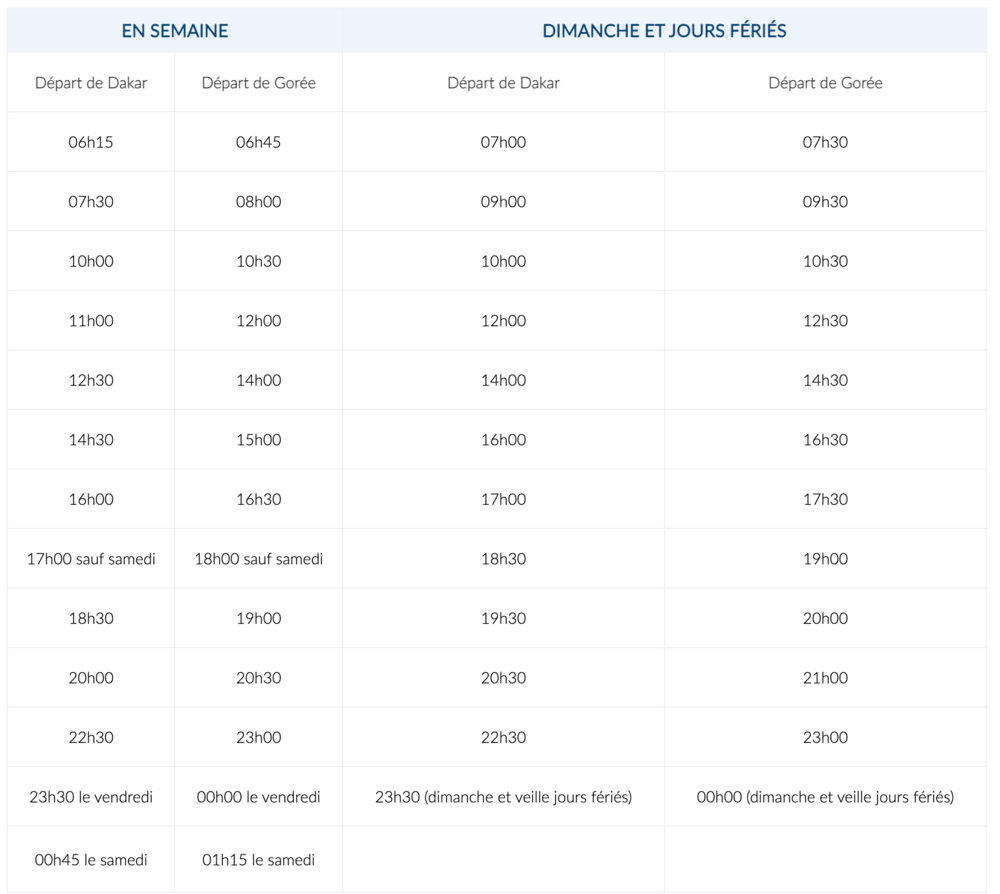
The left two columns show the departure times during the week (Monday-Saturday) and the right two columns show the times for Sundays and Holidays. “Depart de Dakar” is when the boat leaves Dakar for the island. “Depart de Goree” is for the return trip back to Dakar. As you can see, there are two lulls during the day, one in the morning and another at midday. Keep this in mind when planning your trip.
Do you need a guide for Gorée Island?
Guides are not obligatory, but the officially licensed ones (who all wear a vest indicating as much) are generally knowledgeable, friendly and most of them speak multiple languages. Unlike Fadiouth, there is not a fixed price here so you will need to negotiate on the spot. On our last visit, we paid a guide 15,000 CFA for a group of four with minimal negotiation (he started at 20,000 CFA). There are guides everywhere and if you have not already found one, you will be approached (repeatedly).
While the Slave House has placards in French and English, there are many other sites and features of the island that lack explanation without an accompanying guide. You are also putting some additional money into the local economy and supporting someone that has likely spent years honing their craft.
What is there To see and Do on Gorée Island?
The Slave House is the main attraction but even without it Gorée is still worth visiting.
The Slave House
The original curator of the museum, Senegalese historian Boubacar Joseph Ndiaye, did a masterful job positioning Gorée and the Slave House as one of the main protagonists in the horrific Trans-Atlantic Slave Trade. To this day, even UNESCO maintains that the Gorée “was the largest slave-trading centre on the African coast.” Historians have since disputed the number of slaves that were held at, or transited through, the Slave House. Regardless of the actual numbers, the Slave House pays a powerful tribute to this horrific multi-century trade in human beings. The “cells” and the “door of no return” all pack a punch, but the other aspects of the museum, including the bilingual informational placards, are all very well done.
Practical info about the Slave House on Gorée
I would say you need a minimum of 30 minutes to visit the Slave House, but longer than that is of course preferable. You certainly won’t be reading all the info panels in 30 minutes. The museum is closed to the public on Mondays. From Tuesday-Sunday, the hours of the museum are 10:30AM-12PM and 3PM-6PM. Entry to the museum is 1,000 CFA. If you can only make it to the island on a Monday, it is possible to organize a private visit for a supplemental fee of 50,000 CFA. If you get a group together this is not a bad deal, and it would allow you to have a much quieter and more intimate visit.
Musée historique du Sénégal
The other museum on the island is on the north end and it sits inside of the 19th century French Fort d’Estrées, which the French once used to defend the harbor of Dakar. Somewhat more spartan than the Slave House, the Museum does have an interesting collection of items, including artifacts that date to the prehistoric period. All of the placards are in French, however. The fort itself is also worth exploring, and you get a great panoramic view from atop the walls. Like the Slave House, it is also closed on Monday. From Tuesday-Sunday, it is open from 10:30AM – 4:30PM. There is not a midday pause so it can be a good spot to check out when the Slave House is on break. Entry is 3,000 CFA.
Historical buildings and sites
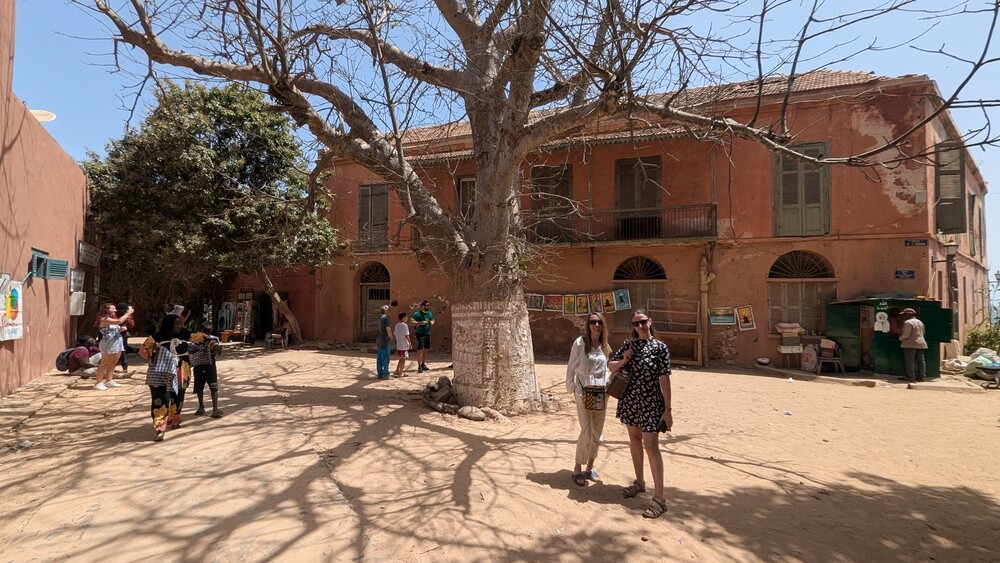
Gorée is only 900 meters long and 300 meters wide, but there is an exceptional density of interesting buildings and historical sites in that small area, from the “guns of Navaronne” and the Gorée Memorial to the many active and former residences. Even if you had no idea what you were looking at, the streets and houses are all atmospheric enough for you to get lost in both body and mind.
Shopping
Gorée has more than its fair share of commercants, and plenty of artists, too. They are all skilled salespeople, but they are also easily turned away with a polite “no, merci.” If you didn’t have much time in Dakar, you could easily do your souvenir shopping here. There are also a few artists, like the sand-painters (a bit after the Slave House and to the left), that are doing some unique work, and even if they put on the canned performance a hundred times a day, it’s still cool to see. \
Where to Eat and Where to Stay on Gorée
There are several restaurants located right at the port. These can be a convenient spot for lunch as you can see whether the line for the departing ferry is starting to fill up. Expect local staples like yassa chicken and thieboudienne. The food is not going to blow your mind, especially if you have already had standout versions of these dishes. What I would do instead is to eat somewhere else and then grab a drink at one of these spots while waiting for the ferry. My dining pick would be either the La Crêpe Saint-Louisienne, an outpost of the crêpe shop from Saint-Louis, or the nearby “Chez Astou” aka La Buvette de la Liberté. If you want more of a restaurant experience, head to Resto du Port.
For lodging, I wholly recommend ASAO, for their accommodating prices, cozy rooms and accompanying mission (the hotel is a non-profit that helps support the arts as well as Empire des Enfants, which provides critical support to street kids). Maison Augustin Ly and Chez Coumbis are also good bets, if more expensive.

0 Comments